


Solar Buy-Back Rates NZ (2026)
Written by
Kristy Hoare, Founder & Solar Market Research Specialist
Last updated:
Most solar homes get paid 8c–17c per kWh for power exported to the grid. You might spot higher “peak” rates of 19c–27c, but there’s a catch. These only apply in the early morning and evening, sometimes just in winter, when your panels aren’t producing much… if anything. You’ll generally need a battery to make the most of them. Even then, if you’re paying around 40c per kWh to buy power, you’re usually better off keeping that stored power for yourself.
All rates below exclude GST. Rates last checked: 15 October 2026.
Solar Buy-Back Rates by Retailer
Contact Energy

8c
25c Good Charge plan, weekdays 7-9am & 6-10pm
None
The 25c peak rate is only on the Good Charge plan, made for homes with solar and a battery.

Electric Kiwi
MoveMaster

10c*
20c* weekdays 7-9am & 5-9pm
10kW
On Electric Kiwi's MoveMaster plan, the 20c peak buy-back (23c incl GST) applies only on weekday mornings (7–9am) and evenings (5–9pm) - times when solar panels produce little or nothing. So unless you're exporting stored solar from a battery during those windows, you're unlikely to sell at that rate. Most if not all solar you produce and export will be sold at the 10c rate (11.5c incl GST). A non solar related benefit of their Move Master plan is cheaper off-peak import rates, half price overnight (11pm–7am).

Mercury

Flat Rates plan: 11.1c. Flex Rates plan: 15.75c (May-Sep), 9.17c (Oct-Apr)
Flex Rates plan: 20.38c (May-Sep), 10.44c (Oct-Apr)
None
Rates differ on some networks, such as Orion.
Meridian

15c open-term plans, 12c fixed-term plans
24c Jul-Sep, 7-10am & 5-9pm
10kW
The 24c winter peak rate applies during morning and evening periods from July to September - times when solar panels produce little or nothing. So unless you're exporting stored solar from a battery, you're unlikely to sell at that rate.

Octopus
Flexi

14c
19c weekdays 7-11am & 5-9pm
10kW max - Larger on application
Only available in certain regions of New Zealand. Click here to find out if this offer is available where you live. Rates are 2c lower in Northpower and Top Energy areas.
Octopus
Peaker

10c
23c weekdays 7-11am & 5-9pm
10 - 20 kW
Only available in certain regions of New Zealand. Click here to find out if this offer is available where you live. Rates are 2c lower in Northpower and Top Energy areas.

Powershop

13c
23c Jul-Sep, weekdays 7-11am & 5-9pm
None
Residential customers only. The peak rate needs a smart meter.

Toast Electric

10.9c* (8.7c* in Wellington)
-
None
Toast quotes 12.5c incl GST (10c incl GST in Wellington). We've shown the rate excluding GST.
*Converted from GST-inclusive rates. Rates can vary by network area - check with the retailer for your address.
The catch with that 24c rate
That 24c rate might catch your eye, but it only applies when demand is high - early morning and evening. That’s when your panels aren’t producing much… if anything. Without a battery, you’re unlikely to export much power at those rates. A battery lets you save solar power to export later, but using it at home could save you more than selling it. Find out more about solar batteries.
Do Buy-Back Rates Include GST?
All rates shown here exclude GST, as that’s what most households receive. If you’re not GST registered, you’ll get the quoted rate as a credit on your power bill. There’s no extra 15% on top.
If you’re GST registered and your solar is part of your business, you may receive the rate plus GST. Some retailers advertise GST-inclusive rates, which can make their offer look a bit sweeter. We’ve taken GST out so you can compare them fairly.
Some retailers show buy-back rates including GST to match how they display their power prices. It makes the number look bigger, but if you’re not GST registered, you’ll get the lower, GST-exclusive rate.
How Do Solar Buy-Back Rates Work?
When your panels produce more power than your home needs, the surplus goes to the grid - unless you have a battery with room to store it. Your power company pays you for each unit (kWh) you export at their buy-back rate. That payment appears as a credit on your power bill.
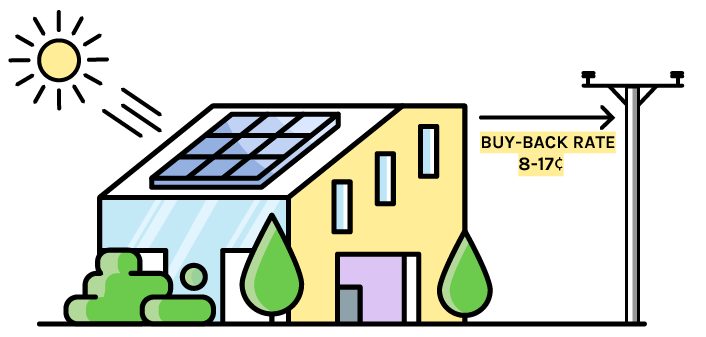
You’ll need an import/export meter to get paid. Your installer and power company will organise this, but it can take a few weeks, so get the ball rolling early.
How Much Is Exporting Actually Worth?
Here's a typical 8kW system - the size most Kiwis are installing now.
| Buy-back rate | Yearly export income |
|---|---|
| 8c | about $420 |
| 12c | about $630 |
| 16c | about $840 |
Based on an 8kW system making about 10,500 kWh a year, with half exported.
The difference between a poor buy-back rate and a great one is around $400 a year. Definitely worth having, but using that power at home could save you much more. For example, if you’re paying 40c per kWh, using that same amount yourself - half your solar generation in this example - would save around $2,100 a year.
Why the Highest Buy-Back Rate Isn’t Always the Best Deal
A generous buy-back rate looks good, but it’s only part of the picture. Before switching power companies, check:
- What you’ll pay for power. Getting an extra 2c per kWh for exports won’t help if you’re paying 3c more for imports and buying more than you sell. Check whether the retailer charges solar customers higher power prices too.
- The daily charge. A few extra cents a day might seem small, but they add up. Daily charges now range from around $1.50 to $3.00 a day, depending on your retailer, plan and region. That’s a difference of over $500 a year - more than you’d gain from even the best buy-back rate.
- The fine print. Do you need to sign up for a fixed term or a particular plan? Is the rate available in your area, and do you need a smart meter?
- System size limits. Check whether your system qualifies. Many standard buy-back offers have a 10kW limit. See our guide to lines company fees and export limits.
Use Your Own Solar First
Using solar power at home saves you buying it from the grid - usually worth around two to three times what you’d get for exporting it. Start with the easy wins: run the dishwasher, washing machine, hot water heating and EV charging during the day.
A home that uses 80% of its own solar won't worry much about the buy-back rate. If you export half, it’s worth shopping around. Try a few different buy-back rates in our solar calculator to see how much they change your savings.
Do You Need a Battery to Get Peak Rates?
To make the most of them, generally yes. Your panels won’t be producing much during peak times, so a battery lets you store solar during the day and sell it later when rates are higher.
But a higher rate doesn’t automatically make a battery worth buying. That depends on what the battery costs, how much power you can export, and whether you’d save more by keeping that power for your own home.
How to Switch Retailers for a Better Rate
- Compare both sides of the deal. Check the daytime buy-back rates above, then compare what you’ll pay for power on Powerswitch.
- Check your system qualifies. Make sure the plan accepts solar and covers your system size.
- Get things moving early. If you’re installing solar, sort out your retailer and the import/export metering beforehand to avoid delays.
- Check again each year. Rates change, so today’s best deal might not stay that way.
FREQUENTLY ASKED QUESTIONS
Right now, Power Edge pays the highest daytime rate at 17c per kWh, followed by Ecotricity (16c) and Meridian (15c). For battery owners exporting at peak times, Power Edge (27c winter peak) and Contact Good Charge (25c) pay the most.
Yes. Most buy-back rates are variable and can change with notice. That's why it's worth checking your rate once a year.
Most retailers cap their standard buy-back at 10kW. Larger systems may get a different rate, or need approval first.
Only if you're exporting it - and solar panels don't produce at night. If you have a battery, you can export stored power in the evening.
Yes, an import/export meter. Peak rates usually also need a smart communicating meter.
Usually as a credit on your power bill. Some retailers will pay out a credit balance to your bank account once a year.
It happens. Always compare the import price as well as the buy-back rate before switching.
Your payback gets a bit longer, but it won't make or break your solar. Most of your savings come from using your own power, not selling it.


