

NZ Solar Power Costs: Prices & Payback Guide (2026)
Written by
Kristy Hoare, Founder & Solar Market Research Specialist
Last updated:
Solar power in New Zealand costs between $7,000 and $19,000 fully installed in 2026, depending on system size (3kW to 10kW). Most Kiwi homes are now going for around 8kW, which costs about $15,500. Adding a battery will set you back between $10,000 and $16,500 extra, depending on size. The most popular 13.5kWh battery costs around $15,000.
Solar on its own typically pays for itself in about 7 years, or around 9 years with a battery.
These prices are based on 151 verified Kiwi solar installs, with an average cost of $2.04 per watt. Kiwis are going bigger, too - new systems averaged 8.6kW from January to August 2026, topping 9kW in July and August.
Sources: My Solar Quotes customer survey (2025); Electricity Authority installed generation data (January to August 2026).
2026 Quick Pricing Guide
- 3kW System: ~$7,000 (small homes, low daytime use)
- 6kW System: ~$12,000 (smaller family homes)
- 8kW System: ~$15,500 (typical new NZ install)
- 10kW System: ~$19,000 (large homes, EV charging)
- Cost Per Watt Benchmark: $2.04/W
- Average Payback: 6.9 years
- Typical yearly savings: about $2,475 (solar only)
- Most Popular Battery: around $15,000 for a 13.5kWh battery
How Much Do Solar Panels Cost in NZ? Prices by System Size
An 8kW solar power system costs around $15,500 fully installed - about the average size going onto Kiwi homes these days. How much you’ll pay mostly comes down to the size of your system, your roof and how easy it is for installers to access. Bigger systems cost more upfront, but you generally get more solar for your money. Once the crew’s up on your roof, chucking on a few extra panels isn’t a massive extra job.
| System size | Number of 500w panels | Typical household | Solar only (incl GST, fully installed) | With a 13.5kWh battery |
|---|---|---|---|---|
| 3 kW | 6 | Small homes, 1–2 people | $7,000 | ~$22,000 |
| 5 kW | 10 | Medium homes 2–3 people | $10,500 | ~$25,500 |
| 6 kW | 12 | Smaller family homes | $12,000 | ~$27,000 |
| 6.6 kW | 13 | Popular search size (see the 6.6kW myth) | $13,000 | ~$28,000 |
| 8 kW | 16 | Typical new NZ install - family home, heat pump | $15,500 | ~$30,500 |
| 10 kW | 20 | Large homes, spa/pool, EV charging | $19,000 | ~$34,000 |
| 15 kW | 30 | Very large home or small business | $26,000 | ~$41,000 |
Battery estimate adds around $15,000 for a 13.5kWh battery, the most common size in our 2025 survey of 63 battery buyers.
Please only use these prices on this page as a guide. Note: Prices are based on our survey and reflect standard single-storey metal roof installations using Tier 1 panels and string inverters.
How do our prices compare with EECA's? EECA estimates a 3kW system at $8,500, a 5kW system at $11,500 and a 10kW system at $20,000. The Kiwis we surveyed paid less than that - $7,000, $10,500 and $19,000. The bigger difference is with batteries: EECA puts a 10kW system with a battery at around $40,000, while our buyers paid a median of $34,500 for 10kW with a 13.5kWh battery.
Get The Best Price For Solar
Use our free 3 Solar Quotes Service to compare competitive prices from vetted, SEANZ approved solar installation companies.
How Much Does A Solar And Battery System Cost In New Zealand?
An 8kW solar system with a 13.5kWh battery costs around $32,000 fully installed in New Zealand. That’s roughly twice the price of solar on its own, with a median payback of 9 years compared with 6.9 years for solar alone.
That extra cost isn’t putting everyone off. About half of new home solar installs now include a battery, according to Electricity Authority data. Here’s what Kiwis are paying for some common setups.
| Solar + battery | Typical household | Typical cost | Price range |
|---|---|---|---|
| 8 kW + 6 kWh | Smaller home, some evening cover | $23,000 | $22,000 - $26,000 |
| 8 kW + 13.5 kWh | Average home, most evenings covered | $32,000 | $30,000 - $36,000 |
| 10 kW + 13.5 kWh | Larger home, EV charging or high evening use | $34,500 | $29,000 - $39,500 |
| 14 kW + 20 kWh | Very large home, EV, pool or spa | $48,500 | $46,000 - $70,000 |
These are median prices, fully installed and including GST, from our survey of homeowners who added solar and a battery between September 2025 and September 2026. We had 4 to 9 responses for each setup, so use these as a guide. Your roof, any switchboard upgrades, the brands you choose and what you want to keep running in a power cut will all affect the price. Most households paid between $30,000 and $35,000. See the full breakdown.
Are Solar Prices Still Falling in NZ?
Yes, although the biggest price drops are probably behind us. Back in 2008, a 3kW solar system would set you back around $40,000 installed. Today, it’s about $7,000 - more than 80% cheaper.
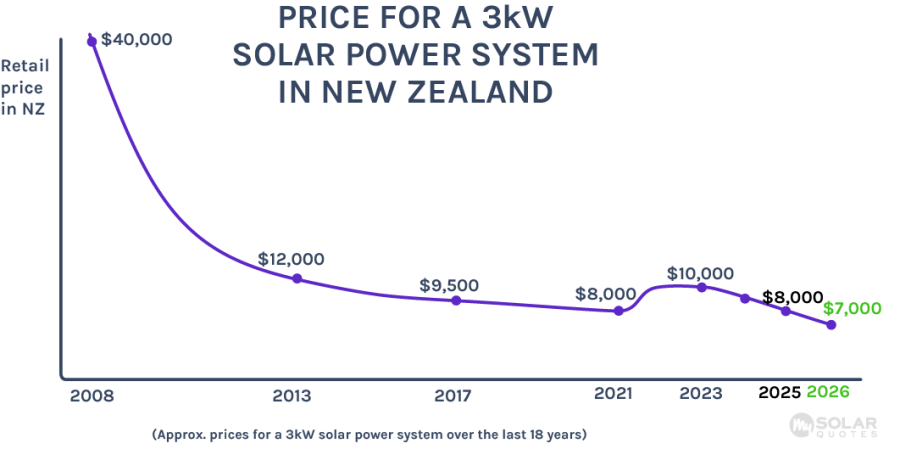
There have been a few bumps along the way. The same-sized system cost around $8,000 in 2021, before supply chain issues and inflation pushed it up to $10,000 in 2023. Prices have since come back down, and are now the cheapest they have ever been.
| Year | 3kW system, installed |
|---|---|
| 2008 | $40,000 |
| 2021 | $8,000 |
| 2023 | $10,000 |
| 2025 | $8,000 |
| 2026 | $7,000 |
Panels are now only about a quarter of the cost of a typical 8kW system. The rest is labour, the inverter, scaffolding and compliance. So prices may ease a little more, but I wouldn't expect another big drop.
Where Our Solar Price Figures Come From
We don’t just estimate what solar should cost - we ask Kiwis what they actually paid. This guide brings together homeowner surveys, installer quotes and Electricity Authority data. Here’s where the numbers come from:
| Data source | What we used it for |
|---|---|
| 151 verified residential solar installs (2025 survey) | System prices and the $2.04 per watt average |
| 63 verified battery installs | Battery costs |
| Solar and battery buyers, September 2025 to September 2026 | Solar and battery package prices |
| 279 residential solar quotes (2026) | Estimated payback and yearly savings |
| Electricity Authority registry data | Average system size and battery uptake |
What do we mean by “verified”? Everyone who responded to our surveys got their quotes through My Solar Quotes, so we can link their response to a real enquiry. We only refer homeowners to SEANZ-member installers. The prices are what homeowners told us they paid, rather than figures we’ve checked against invoices.
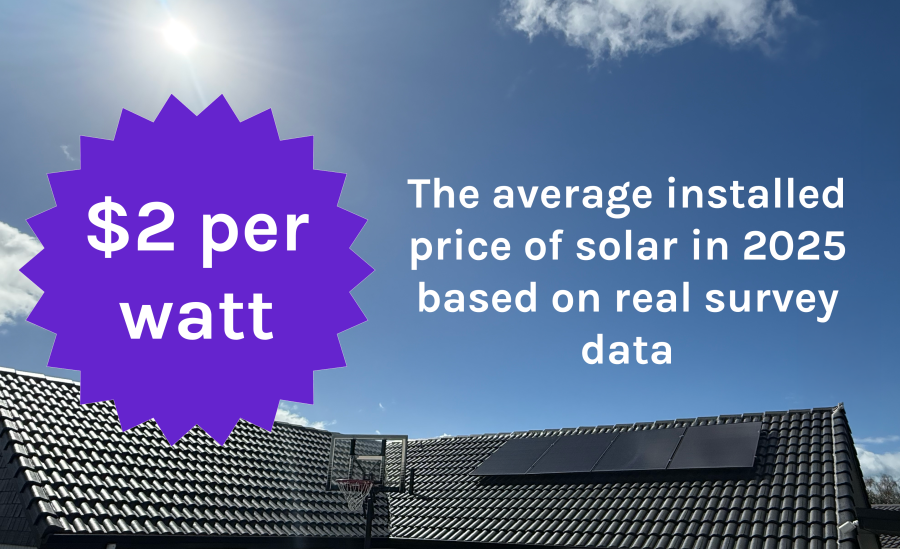
How much do prices vary? The average was $2.04 per watt, with the middle half of installs costing between $1.74 and $2.36 per watt. A tricky roof, microinverters or premium panels can push the price towards the higher end.
A couple of things to keep in mind: these surveys give us a useful snapshot of what Kiwis are paying, but every home is different. The payback and savings figures are also installer estimates from quotes, rather than results measured over years of use.
Data compiled and analysed by Kristy Hoare, founder of My Solar Quotes.
Get Solar Panels The Easy Way, Get 3 Free Solar Quotes Now
What Affects the Cost of Solar Panels in NZ?
The size of your system makes the biggest difference to the price. After that, it’s the brands you choose, any extra doodads, your roof and how straightforward the installation is. Not to mention you'd expect to pay a touch more for a solar power system that is going to look after you for the lifetime of the system.
- System size: bigger systems cost more upfront, but you get more solar for your money. Systems under 5kW average $2.54 per watt, compared with around $1.90 for a 10kW system.
- Equipment: microinverters and premium panels can push the price towards the higher end of the range, around $2.36 per watt.
- Roof type: metal roofs are generally the easiest and cheapest to install on. Tile and shingle roofs usually cost more.
- Scaffolding: a two-storey home or steep roof usually means scaffolding, which adds to the bill.
- Switchboard upgrades: if your switchboard is older or doesn’t meet current requirements, it may need an upgrade or replacement.
- Location: if you’re off the beaten track, expect extra travel costs.
- Aftercare: some installers include ongoing monitoring, check-ups or support for the life of the system. Expect to pay a bit more for that, but it can be worth it for peace of mind. Check what's included before comparing quotes on price alone.
- Optional extras: things like a hot water timer, EV charger, bird proofing, consumption monitoring or a battery-ready inverter can all add to the price. Check which extras are included before comparing quotes.
- Lines company fees: these usually range from $80 to $350, although some companies don’t charge at all. See below.
How Much Are Lines Company Fees for Solar in NZ?
Getting the go-ahead from your lines company usually costs between $80 and $350, with an average fee of around $140 in 2026. The good news? Around 9 of NZ’s 30-plus lines companies don’t charge for standard home systems, including Aurora Energy, Powerco, Vector and MainPower.
You might also have an inspection fee to pay, although that’s less common. Your installer will usually sort the application for you - just check whether the fee is included in your quote.
Your lines company may also put a limit on how much solar power you can send back to the grid. That’s worth checking before you settle on a system size.
Check your local lines company’s fees and export limits>
Why Get More Than One Solar Quote?
You might be surprised how much prices vary for a similar-sized system. In our survey of homeowners with 7 to 9kW systems, half paid between $13,300 and $18,000. That’s nearly $5,000 between the two ends of that range.

But the cheapest quote isn’t automatically the best buy. Putting a few quotes side by side helps you work out where the extra money goes - and whether it’s worth paying.
- Equipment: check which panel, inverter and battery brands you’re getting, and how the products compare.
- Warranties: look at what’s covered, for how long, and who’ll help if something goes wrong.
- Aftercare: will the installer still be there to help once the panels are on the roof?
- The installer: getting quotes gives you a feel for who knows their stuff, answers your questions and gets back to you.
Want to save yourself a few phone calls? Get up to 3 quotes through My Solar Quotes and compare trusted local installers.
Source: My Solar Quotes 2025 price survey, 38 homeowners with 7 to 9kW systems.
How Many Solar Panels Do You Need?
New home solar systems in NZ are typically around 8 to 9kW - that’s 16 to 18 panels at 500W each. How many you need comes down to how much power you use, the space on your roof and your budget.
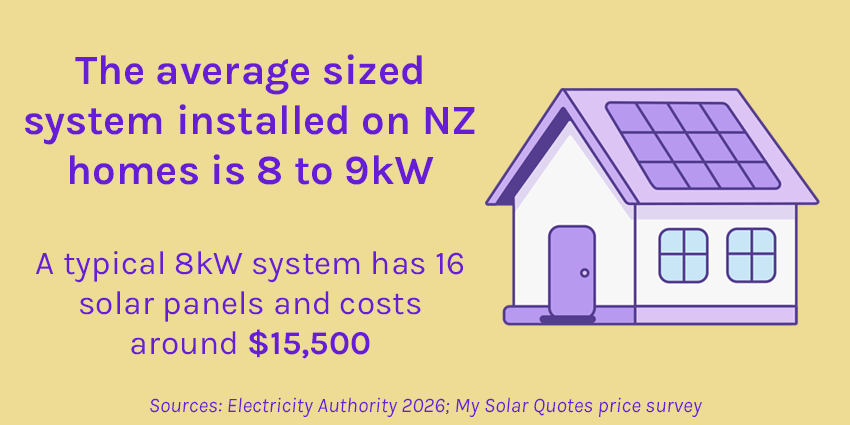
Going smaller won’t necessarily give you a better return. In our quote data, systems under 5kW had a median payback of 11.1 years, compared with 6.6 to 7 years for systems between 5 and 12kW. You’re paying to get the crew and equipment on site either way, so a few extra panels can make good financial sense.
There are a few ways to approach it:
- Work with your budget: get up to 3 quotes, tell installers what you’re comfortable spending and see what they recommend.
- Go for the best return: use our solar calculator to compare sizes and see which could pay for itself fastest.
- Make the most of your roof: keen to go big? Installers can use satellite images to work out how many panels will fit, then check what’s practical for your home.
Not sure what size to go for? Read our guide: How many solar panels do I need?
Is Solar Power Worth It in NZ?
For most Kiwi homes, yes - the numbers stack up. A solar-only system typically pays for itself in about 7 years and saves around $2,475 a year, based on 279 residential solar quotes from 2026. That’s roughly a 14% annual return through power savings, with rising power prices giving you even more reason to generate your own.
EECA's guide says 7 to 10 years and savings of $1,000 or more a year. Our figures come out better mainly because Kiwis are now putting on bigger systems - around 8 to 9kW, rather than the 3 to 5kW systems EECA bases its savings on.
Most panels come with a 25 to 30-year performance warranty. If your system pays for itself in around seven years, that leaves plenty of years to enjoy cheaper power. Just allow for maintenance and a possible inverter replacement along the way.
There’s more to it than the savings, too. Making your own power means you’re less reliant on your retailer and a little less at the mercy of the next price rise. Add a battery with backup capability and you can keep the essentials running during a power cut - handy if you’re rural or usually the last house to get the power back on.
There’s an environmental benefit as well. NZ already gets most of its electricity from renewables, but we still use gas and coal when hydro and wind aren’t enough. Solar can help reduce that reliance during the day, while a battery lets you save some of that sunshine for the evening.
And if you move before the system has paid for itself? A major NZ study found solar panels can add value to a home, so you may recover some or all of the cost when you sell.
To get an idea of what solar could save at your place, try our solar calculator. You can also see the full 2026 payback data.

Buying Solar in NZ? Start With Our Buyers Guide
Solar is a big purchase for most, and making sense of the quotes can take a bit of homework. Our solar buyers guide helps you work through it, from figuring out the right system size to knowing what you’re signing up for. We cover:
- how to spot a dodgy trader
- what to check when comparing quotes
- questions worth asking before you commit
Already have a few quotes? Upload them to our free quote comparison tool to see them side by side in minutes.

How Much Does a Solar Panel Cost in NZ?
A single 450 to 500W solar panel costs around $150 to $400 in NZ, depending on the brand. Most mainstream panels supplied by installers work out at about $200 to $300 each.
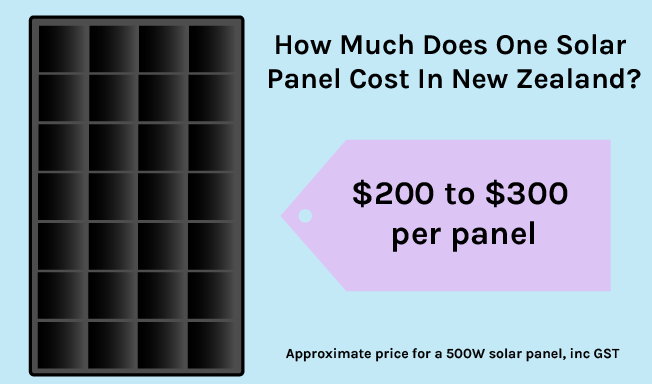
But there’s a fair bit more to a solar system than the panels. For a typical 8kW system with 16 panels, they account for roughly a quarter of the $15,500 installed price. The rest pays for the inverter, mounting gear, cabling, electrical work, scaffolding, paperwork and lines company application.
So a bargain panel at the hardware store is only part of the story. You still need to get it safely installed and connected, with a registered electrician and approval from your lines company. The quality of the installation and who’ll help if something goes wrong matter just as much as the price of the panels.
And just quietly, I rarely recommend buying solar gear from a hardware store. Here’s why.
You don’t need to buy the fanciest brand, either. Mid-range panels can be a good buy, especially with solid product and performance warranties behind them. Read our guide to choosing solar panels.
Should I Wait for Solar Prices to Fall?
Short answer: probably not. Prices might come down a bit more, but your power bill won’t take a breather while you wait.
Our 2026 quote data puts estimated savings from a typical solar-only system at around $2,475 a year. Wait another year and you’re giving up those potential savings, so you’d want a fairly decent price drop to make it worthwhile.
And prices don’t always head down. A 3kW system cost around $8,000 in 2021, jumped to $10,000 in 2023, then came back down again. Timing your purchase perfectly is a bit of a guessing game.
Panels are getting better, too, but the ones available now are already pretty good. According to Fraunhofer ISE’s Photovoltaics Report, commercial panel efficiency has gone from around 17% to just under 25% over the past decade. Waiting might get you a bit more power from the same roof space, but in the meantime, that roof could already be earning its keep.
If solar makes sense for your home and budget now, I’d get on with it. Still on the fence? Get a few quotes and see what it could cost and save at your place.
How Much Does a Solar Battery Cost in NZ?
Adding a battery when you install solar costs around $13,000 on average in NZ. That gets you roughly 11kWh of storage, with most buyers paying between $10,000 and $16,500, depending mainly on size.
As with solar panels, going bigger generally gets you more for your money. In our survey, 5 to 7kWh batteries averaged about $1,530 per kWh of storage, compared with around $1,110 per kWh for 12 to 15kWh batteries. That doesn’t mean you should buy the biggest one going - it still needs to suit how much power you’ll use.
| Battery size | Typical price | Half paid between | Per kWh |
|---|---|---|---|
| 5 to 7 kWh | $8,000 | $6,800 to $9,750 | $1,530 |
| 8 to 12 kWh | $10,500 | $10,000 to $13,000 | $1,240 |
| 12 to 15 kWh | $15,000 | $12,500 to $16,600 | $1,110 |
| 15 kWh and over | $18,000 | $17,250 to $18,200 | $1,090 |
Prices are for the battery component, installed alongside solar, including GST. Source: My Solar Quotes 2025 price survey of 63 solar and battery buyers. There were only 8 buyers each in the 5 to 7kWh and 15kWh+ groups, so take those figures as a rough guide.
Sigenergy and Tesla Powerwall were the most popular brands among our buyers. The brand you choose, whether you want backup during power cuts, and how the battery connects to your system will all have a say in the final bill.
Is the extra cost worth it at your place? See how the numbers compare, or compare solar battery models and prices.
Get 3 Free Quotes For Solar Panels And Batteries>
How Can I Pay for Solar in NZ?
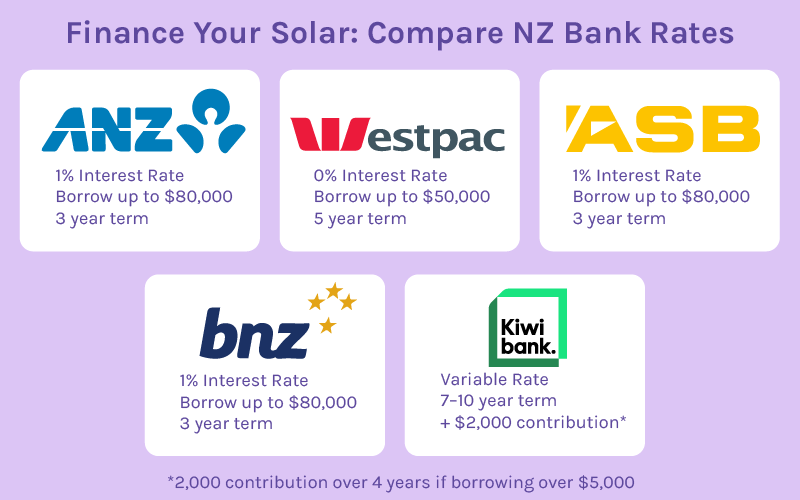
There’s no government grant for home solar in NZ, but most of the big banks offer 0% to 1% green loans for solar and batteries, usually as a top-up to your home loan:
- Westpac: 0% for up to 5 years, up to $50,000
- ANZ, ASB and BNZ: 1% fixed for 3 years, up to $80,000
- Kiwibank: standard home loan rate, plus up to $2,000 cashback
You’ll usually need your mortgage with that bank and a formal installer quote. ANZ requires your solar or battery quote to come from a SEANZ member. The other banks don’t specify, but using a SEANZ member installer is a safe bet. Have a chat with your bank about what’s available and check what rate kicks in once the low-interest deal ends. The offers can change, so it pays to check before you count on one.
Compare NZ solar finance options>
How Much Do NZ Power Companies Pay for Solar?
Most NZ power companies pay between 8c and 17c per kWh for solar power you send back to the grid (excluding GST). That’s a lot less than the roughly 33c per kWh you pay for power from the grid (excluding daily charges), so using your solar at home during the day will usually give you the best bang for your buck.
Some retailers offer higher peak rates of around 20c to 27c per kWh. But this rate only really applies if you have a battery, as peak times often fall when your panels are producing little or no power.
Compare solar buy-back rates from every NZ power company>
The 6.6kW Solar Myth: What Size Do NZ Homes Really Need?
Seen 6.6kW called the “most popular” solar system size? That’s an Aussie import. It doesn’t tell you much about what belongs on your roof here.
- Why it’s big across the ditch: many Australian homes have a 5kW inverter limit, and rebate rules allow roughly a third more panel capacity than inverter capacity. That combination made 6.6kW a common setup.
- How it works here: NZ has no solar rebates or special 6.6kW rule. Your lines company’s export limit matters, but so do your roof space, power use and budget.
- What Kiwis are actually installing: new home solar systems averaged 8.6kW between January and August 2026, according to Electricity Authority data. The average across all existing home systems is about 5.8kW, pulled down by the smaller systems installed years ago.
There’s no magic number that suits every home. Get up to 3 quotes and have installers recommend a size based on your roof and how you use power.
Ready to Get Solar on Your Roof?
Tell us a bit about your place and we’ll put you in touch with up to 3 trusted local solar installers. They’re all SEANZ members, and our service is free, with no pressure to go ahead.
Have a chat, ask your questions and compare what’s on offer. You decide who’s the right fit for you.
FREQUENTLY ASKED QUESTIONS
It can. A major New Zealand study found solar panels can lift a home’s value.
So moving before your system has paid for itself doesn’t necessarily mean losing out. You may get some or all of that investment back in the sale price, although it’s not guaranteed.
Most come with a 25 to 30-year performance warranty, but they don’t suddenly pack it in when the warranty ends. Many keep generating well beyond that, with output gradually dropping as they age.
The inverter will usually need replacing sooner. Allow for a replacement along the way, often after 10 to 15 years.
Around $19,000 fully installed, based on our survey of 151 verified installs. That’s roughly 20 panels at 500W each, and it can be a good fit for a household using plenty of power - especially with heat pumps or an EV to charge.
Add a 13.5kWh battery and the total comes to around $34,000. Whether you need that much solar comes down to your power use, rather than just the size of your house.
No, there’s no national government rebate or subsidy for home solar. But you may be able to get a low-interest green loan through your bank, with rates of 0% to 1% for the first few years. Compare NZ solar finance options.
Not usually. Around 9 of NZ’s 30+ lines companies charge no application fee for standard home solar systems, including Aurora Energy, Powerco, Vector and MainPower. Where there is a fee, it’s typically $80 to $350. Most installers handle the application for you and include the fee in their quote. Check your local lines company’s fees and export limits.
More or less, yes. Our 2026 quote data puts the median price at around $16,900 for solar alone, compared with $31,500 for solar and a battery. An average 11kWh battery accounts for about $13,000 installed.
The median estimated payback stretches from roughly 7 years to 9, so you’ll wait a bit longer to get your money back. For many Kiwis, that’s a fair trade for using their own solar in the evening and having backup when the power goes out. Just check that backup is included in your setup - it’s not a given with every battery.
NZ power retailers currently pay around 8c to 17c per kWh for the solar power you send to the grid. That’s a lot less than the roughly 33c per kWh you pay for power from the grid (excluding daily charges), so you’ll usually get the best return by using as much of your own solar as you can during the day. Compare solar buy-back rates.
Most of the big banks offer low-interest green loans for solar and batteries, usually as a top-up to your home loan:
- Westpac Greater Choices: 0% for up to 5 years, up to $50,000
- ANZ Good Energy: 1% fixed for 3 years, up to $80,000
- ASB Better Homes Top Up: 1% fixed for 3 years, up to $80,000
- BNZ Better Future: 1% fixed for 3 years, up to $80,000
- Kiwibank Sustainable Energy Loan: standard home loan rate, plus up to $2,000 cashback
You’ll usually need your mortgage with that bank and a formal installer quote. ANZ requires your solar or battery quote to come from a SEANZ member, and using a SEANZ member installer is a safe bet with the other banks too. Offers change, so check with your bank first. Compare NZ solar finance options.
For most homes, no - one less thing to sort. Since 23 October 2025, roof-mounted solar arrays under 40m² don’t need building consent in areas up to and including a high wind zone. Larger arrays and those in higher wind zones can also be exempt if a Chartered Professional Engineer designs or reviews the fixings.
A 16-panel system covers roughly 32m², while 20 or more panels can put you around the 40m² mark, depending on panel size. The installation still needs to meet the Building Code. Your installer should check what applies to your roof.
Our 2026 analysis of 279 residential solar quotes found a median estimated payback of 6.9 years for solar alone, or around 9 years with a battery.
These are the figures installers put in their quotes, so treat them as estimates rather than a promise. Your power use, system price and electricity plan will all make a difference. See the full 2026 payback data.
Around $2.04 per watt installed is the average from our survey. Half of the homeowners paid between $1.74 and $2.36 per watt. Smaller systems generally cost more per watt, so make sure you’re comparing similar-sized setups.
A quote above that range isn’t necessarily overpriced - a tricky roof or premium gear could explain it. But ask the installer to talk you through it. And if a quote looks like an absolute bargain, check the installer’s credentials, SEANZ membership and warranties before jumping in.


